

15-10-26
Packaging is entering a new phase in Europe. Reducing unnecessary materials, improving recyclability, incorporating recycled content and moving towards reuse models are no longer simply voluntary sustainability goals: they are part of the new European regulatory framework.
<span”>Regulation (EU) 2025/40 on packaging and packaging waste sets new rules for packaging placed on the European Union market and for the management of packaging waste.
It entered into force on 11 February 2025 and has applied generally since 12 August 2026, although many of its obligations will be introduced progressively over the coming years, with 2030 as one of the key milestones for the sector.
This new framework, known as the Packaging and Packaging Waste Regulation (PPWR), aims to transform the way packaging is designed, produced, used and managed across Europe.
But what does the PPWR actually change, and what should companies that manufacture or use packaging start reviewing?
01. What is the PPWR?
The PPWR progressively replaces the previous European framework based on Directive 94/62/EC and sets requirements covering the entire packaging life cycle: from design and manufacture to reuse, collection, sorting and recycling.
Its scope is broad. The Regulation applies to all packaging placed on the European Union market and all packaging waste, regardless of the material used or the type of packaging.
This includes, among others, sales packaging, grouped packaging and transport packaging.
The underlying objective is clear: generate less waste, use materials more efficiently and keep resources in the circular economy for longer.
02. Less packaging and better right-sizing
One of the central ideas behind the PPWR is to avoid unnecessary packaging.
By 1 January 2030 at the latest, manufacturers or importers will have to ensure that packaging is designed so that its weight and volume are reduced to the minimum necessary to maintain its functionality.
The Regulation also focuses on certain features whose sole purpose is to make the product appear larger, such as double bottoms, double walls or unnecessary layers.
This may lead to packaging that fits products more closely, lighter structures and a broader review of the amount of material used.
Empty space is also part of the equation. For certain grouped, transport and e-commerce packaging, the PPWR sets limits on the proportion of empty space.
In other words: packaging right-sizing will become increasingly important.
03. Recyclability becomes part of packaging design
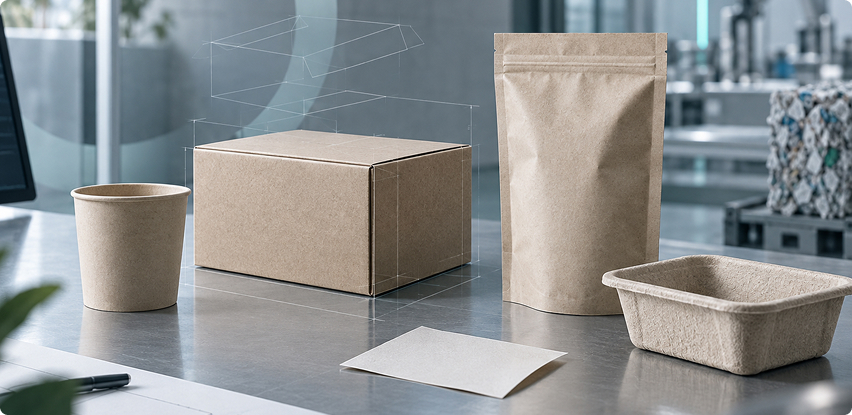
The Regulation requires packaging placed on the market to be recyclable and establishes a system for assessing its recyclability performance.
From 2030, and as the technical criteria provided for under the Regulation are developed, this assessment will be linked to the concept of Design for Recycling (DfR).
It is no longer enough to consider what happens to packaging at the end of its useful life. Its recyclability must start to be considered at the design stage.
Materials, structures, components, labels, closures and bonding systems can all form part of that discussion.
04. More recycled content in plastic packaging
The PPWR sets minimum percentages of recycled content from post-consumer plastic waste for certain categories of plastic packaging, with targets beginning around 2030 and increasing towards 2040.
The percentages are not the same for every format. The Regulation therefore distinguishes, among others, certain contact-sensitive packaging mainly made from PET, single-use plastic beverage bottles and other categories of plastic packaging.
Each company will therefore need to assess which specific requirements apply to its materials, formats and applications.
05. Reuse and refill: another part of the circular economy
The Regulation also promotes reuse and refill for certain packaging categories.
Specific targets apply to certain formats and activities, including some transport packaging, grouped packaging and beverage packaging.
Requirements, percentages and exemptions vary according to the type of packaging and its use, so there is no single rule that applies in every case.
For some companies, this may mean reviewing not only packaging design but also logistics, return systems, storage and handling processes.
06. New labelling and information rules
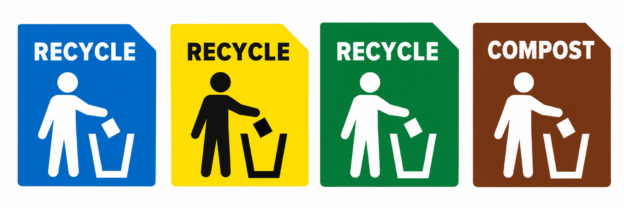
The PPWR also aims to make it easier for consumers and operators to identify materials and understand how packaging should be handled after use.
The Regulation provides for a harmonised labelling system relating to material composition and sets out a phased timetable for implementation.
It also provides for the use of digital information carriers, including QR codes, in certain cases involving information on reuse, sorting or composition.
Packaging redesign will therefore not be purely physical. The information accompanying the pack will also play an increasingly important role.
07. What does the PPWR mean for packaging processes?
A lighter box, a new grade of board, a structure containing recycled material, a right-sized format or a reusable solution can all change process conditions. In adhesive application, for example, temperature, adhesive quantity, bead position, application pattern, production speed or bond strength may all need to change.
That is why packaging transformation can demand more than simply replacing one material with another. It may require trials, process adjustments, new configurations, retrofits, control and measurement systems, or the integration of new solutions into the production line.
The challenge is to industrialise the change: to ensure that the new packaging works in production with the reliability, quality and throughput required for each application.
This means looking at the project more broadly: what changes in the packaging, how that affects the process and which adaptations are needed to bring the new concept into production.
When packaging changes, is the production process ready to change with it?
08. Meler as a technology partner in packaging transformation
The PPWR regulates packaging and packaging waste. Meler’s role in this new context is not to certify packaging compliance, but to support packaging manufacturers and end users when changes to a material, format or packaging system require a review of how that packaging is brought into production.
In these projects, the starting point does not have to be a specific piece of equipment. First, it is necessary to understand what is changing, which conditions the process must maintain and which variables need to be validated. From there, Meler can contribute expertise in adhesive application, trials, parameter adjustment, control, measurement, retrofit and in-line solution integration.
Meler’s experience in real packaging transformation projects means these changes can be approached from a process perspective. In some cases, the challenge may be to work with a new material; in others, to adapt the adhesive pattern or position, maintain bond quality at a different speed, reduce consumption or introduce greater control over the application.
09. Adhesive optimisation: one of the levers
Within this wider transformation, Meler can help manufacturers optimise adhesive application processes and use resources more efficiently.
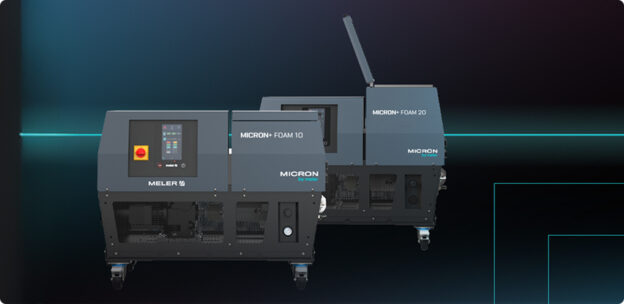
FOAM Technology tackles adhesive savings by mixing hot melt adhesive with a gas, usually nitrogen. The expanded structure increases volume and coverage while using less adhesive than a conventional application over the same contact area between two substrates.
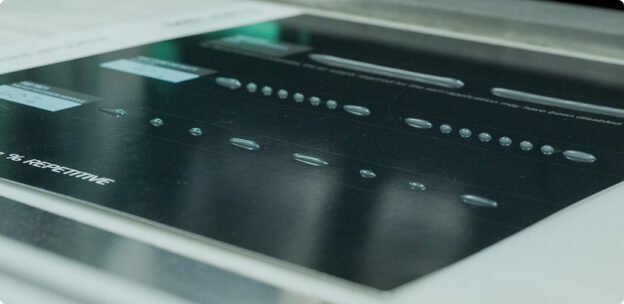
Splitter approaches savings by optimising the activation signal. Where the application allows, this pattern generator replaces a continuous bead with an intermittent dotted application. The user set the desired savings percentage from the touchscrean, and the system automatically calculates the optimum pattern in real time.
The aim is to challenge a common practice that is often accepted by default simply because it works: is a continuous bead really necessary for that application?
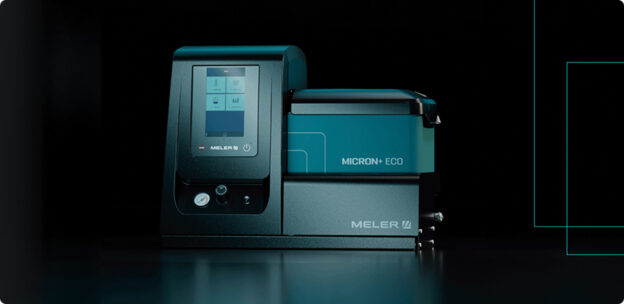
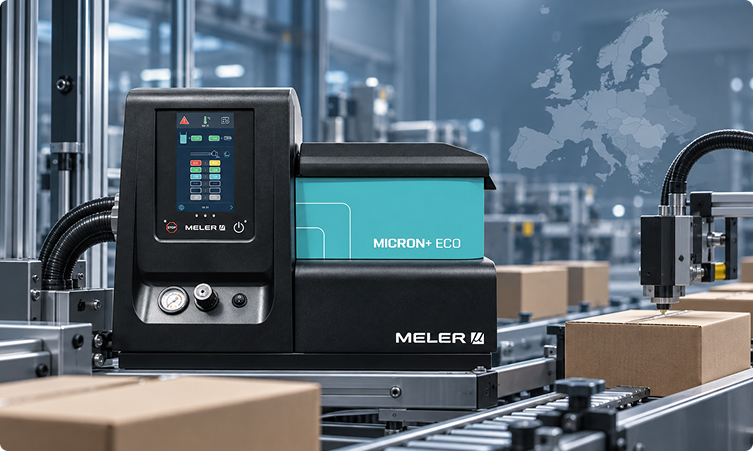
The MICRON+ ECO brings the same philosophy to the overall energy efficiency of the melting and pumping process. Thanks to its cylindrical low-metal-mass tank, advanced insulation and on-demand melting, it minimises heat losses and electricity consumption.
Although the energy efficiency of a melter is not a direct requirement of packaging regulations such as the PPWR, it fits naturally within a sustainable industrial strategy focused on optimising resource use and reducing the carbon footprint..
The starting point should never be to reduce adhesive at any cost, but to understand what each process actually requires and where there is room for optimisation without compromising bond strength or bonding performance.
10. PPWR: a change that goes beyond 2026
The fact that the PPWR has applied generally since August 2026 does not mean that all its requirements take effect on the same day.
The Regulation sets out a phased timetable extending to 2030, 2035, 2040 and beyond, while the European Commission continues to develop delegated acts, implementing acts and technical criteria needed to specify some of its obligations.
For packaging manufacturers and users, the current period is therefore an opportunity to start reviewing.
- Review materials.
- Review formats.
- Review how much is being used.
- Review what can be simplified.
- And review the processes used to manufacture each pack.
Because, beyond regulatory compliance, one of the PPWR’s most relevant messages for industry is this: using resources better starts with understanding how much we really need.
11. FAQS
PPWR stands for Packaging and Packaging Waste Regulation. It is the name commonly used for Regulation (EU) 2025/40 on packaging and packaging waste.
The Regulation entered into force on 11 February 2025 and has applied generally since 12 August 2026. Many of its obligations have later timelines, particularly from 2030 onwards.
The PPWR affects packaging placed on the European Union market and packaging waste. The specific obligations depend, among other factors, on each economic operator’s role, the type of packaging, the material and its application.
The PPWR requires packaging placed on the market to be recyclable and establishes Design for Recycling criteria and recyclability performance levels that will apply progressively. The Regulation also provides for certain exemptions.
Yes. Meler has experience in real projects where changes to materials, formats or packaging systems have required the adhesive application process and its integration into the production line to be adapted.
Meler’s contribution can range from trials and parameter adjustment to control and measurement systems, retrofit and integration of new solutions. The aim is to help customers bring packaging changes into production while maintaining the reliability, quality and performance required by each process.
Examples include paper film solutions applied over product trays as alternatives to plastic, the Self-Ready packaging concept, conical fruit trays, palletising applications and paper film for magazine wrapping.
Content updated in October 2026. This information is provided for general information purposes. To determine the requirements applicable to a specific item of packaging, product or activity, Regulation (EU) 2025/40 should be consulted and, where necessary, specialist technical or legal advice sought.
Comments
Leave a reply
Your e-mail address will not be published. Required fields are marked with an asterisk *.